
English 

+86-158-5501-9595
leizhang112@126.com
leizhang112@126.com
No. 8, Lanzhou Road, Su-Chu Modern Industrial Park, Chuzhou City, Anhui Province


Views: 0 Author: Site Editor Publish Time: 2026-11-10 Origin: Site


Curing time remains the ultimate bottleneck in appliance manufacturing today. It directly dictates both your daily production throughput and the long-term energy efficiency of the final product. Plant managers constantly face a difficult balancing act. You want aggressive cycle times to maximize yield and hit ambitious targets. However, pushing the demold process too fast risks material instability. This leads to severe post-expansion or structural foam shrinkage defects.
To solve this tension, you must align chemical formulation, environmental controls, and foaming equipment architecture. Doing so establishes an optimal, scalable curing baseline for your factory floor. We will explore how specific environmental variables interact to dictate your curing parameters. You will learn to navigate the physical constraints of various factory layout configurations. Finally, we will outline concrete testing protocols to safely verify your baseline without ever compromising insulation integrity.
Curing time dictates both the structural integrity of the refrigerator door and the overall OEE (Overall Equipment Effectiveness) of the production line.
Environmental variables—specifically ambient humidity and mold temperature—require dynamic compensation in curing schedules.
The choice between a rotary door foaming equipment setup and a rectangular layout directly limits or expands your minimum achievable curing and demold times.
Upgrading to advanced high-pressure metering ensures uniform mix ratios, reducing required curing safety margins and preventing premature insulation aging.
Incorrect curing schedules introduce massive financial risks to appliance production operations. When operators demold panels prematurely, the polyurethane (PU) core remains under-cured. The internal gas pressure exceeds the polymer network's yield strength. This triggers "post-blow," a defect where the door bulges outward after leaving the mold. Post-blow permanently warps the metal casing, destroying the aesthetic and rendering the unit scrap.
Conversely, excessive curing times create severe production bottlenecks. If a panel needs three minutes to cure but stays in the press for five, you lose crucial daily capacity. This inflated cycle time drives up the energy consumed per unit. Manufacturers must strike a precise balance to maintain profitability.
Curing completeness directly influences the lifespan of the appliance's thermal insulation. PU foam relies on microscopic, closed-cell structures to trap insulating gases. Proper curing ensures these cell walls harden fully before facing atmospheric pressure changes. Highly stable cell structures retain third-generation blowing agents—like HFOs—much longer. When you cure foam correctly, you prevent premature thermal aging. The refrigerator maintains its energy efficiency rating over its entire lifecycle.
An optimized curing setting represents the shortest possible demold time achieving zero dimensional shift. You must achieve a consistent core density across the entire panel. Success means the door pops out of the mold perfectly flat. The foam matrix must exhibit uniform distribution, showing no voids or brittle patches near the injection point.
Different chemical formulations feature highly distinct exothermic reaction curves. These curves demand specific curing durations. Formulations using Cyclopentane react differently than those utilizing HFOs (Hydrofluoroolefins). Cyclopentane boils at approximately 49°C. The exothermic heat generated by the isocyanate-polyol reaction vaporizes the blowing agent, expanding the foam. HFO systems often react faster and generate distinct heat profiles. Chemical suppliers engineer specific catalyst packages to accelerate this cross-linking. You must adjust your demold timers whenever you switch blowing agents.
Temperature controls everything in polyurethane chemistry. A successful curing process relies on a delicate triad of temperatures. If one falls out of spec, the entire reaction falters.
Baseline Temperature Matrix Guidelines
Variable | Target Range | Impact on Curing Process |
|---|---|---|
Raw Material (Polyol/Iso) | 20°C – 25°C | Determines initial viscosity and blending efficiency inside the mix head. |
Mold Fixture | 40°C – 45°C | Accelerates surface skin formation. Too cold causes poor adhesion; too hot boils the blowing agent. |
Ambient Shop Air | 22°C – 28°C | Influences the cooling rate of the mold carriers and the equilibrium of the foam post-demold. |
High ambient humidity wreaks havoc on curing times. Isocyanate reacts eagerly with moisture in the air. When ambient humidity exceeds 60%, the excess moisture reacts with the isocyanate to produce carbon dioxide and urea. This unintended reaction steals isocyanate away from the primary polyol reaction. The result is a brittle, weak surface skin and poor adhesion to the metal door liner. Production managers must dynamically compensate for seasonal humidity spikes. Often, you must increase curing time slightly during humid months to ensure the structural integrity of the panel.
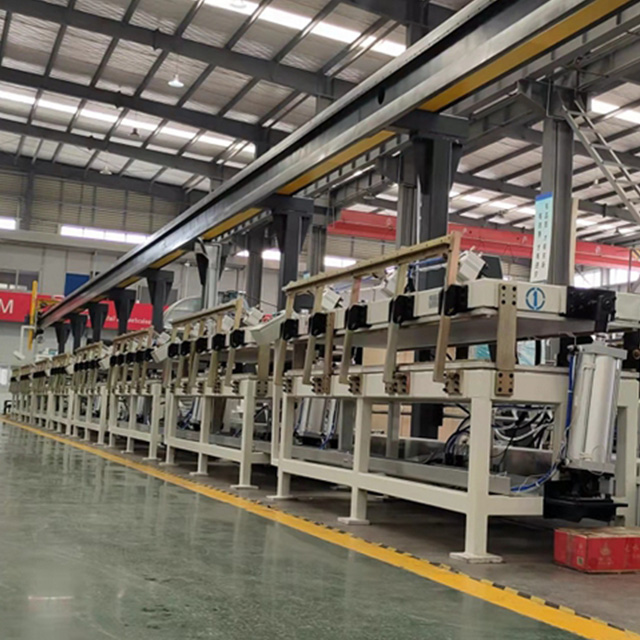
Facility layouts dictate what type of curing times you can realistically implement. Plant engineers must map their footprint against output demands. You cannot simply program a faster cure time if the physical machinery cannot transport the molds quickly enough. The equipment architecture fundamentally limits or expands your manufacturing flexibility.
Rotary systems arrange mold carriers in a circular carousel. This continuous motion offers immense efficiency for specific operational models.
Best for: High-volume, standardized production runs involving identical door sizes.
Curing Dynamic: Curing time is physically locked to the rotation speed and the total number of mold stations. If you operate an eight-station rotary door foaming equipment setup, the drum must complete its rotation precisely as the first panel finishes curing. This rigid setup requires highly stable, fast-curing chemical systems. You cannot easily adjust the time for just one station without halting the entire drum.
Rectangular systems utilize independent carriers moving along a track, often utilizing parallel heating and cooling zones.
Best for: High-mix, flexible production environments handling multiple door sizes and appliance models.
Curing Dynamic: A rectangular door foaming line allows much more independent control over individual mold carriers. If you run a thicker door profile requiring an extra 45 seconds of cure time, the system can route it accordingly. You can accommodate varied formulations without halting the entire production line. This flexibility proves invaluable for factories producing complex product portfolios.
Setting the curing baseline requires precise empirical data, not guesswork. Industry best practices dictate using thermocouple profiling. Quality assurance engineers drill tiny access ports into sample molds. They insert K-type thermocouples directly into the center of the injected foam mass. A data acquisition system maps the core temperature as the foam expands. The exact peak of the exothermic reaction tells you when the cross-linking reaches its maximum velocity. Once the temperature begins to drop, the primary curing phase is complete.
Before testing inside closed molds, operators perform free-rise cup tests. They track the visual and physical progression of the polymer network using established milestones.
Cream Time: The liquid mixture turns opaque and begins to expand.
String Time (Gel Time): The operator dips a wooden probe into the rising foam. When they pull it away, the polymer forms fine strings. This indicates the transition from liquid to solid.
Tack-Free Time: The surface of the foam no longer feels sticky to a gloved finger.
End of Rise: The foam stops expanding entirely.
You calculate your initial closed-mold curing time by multiplying the free-rise tack-free time by an established safety factor, usually 1.5 to 2.0.
You cannot verify curing success solely at the demold station. You must implement a strict 24-hour dimensional stability test. Engineers measure panel thickness immediately after demolding using digital calipers. They place the door in a temperature-controlled holding area. Exactly 24 hours later, they measure the identical points again. If the thickness increases by even a fraction of a millimeter, the foam suffered post-expansion. You must increase the curing time to correct this defect.
Never run your curing timers at the absolute ragged edge of failure. You must document safety margins to account for seasonal ambient shifts. A curing time working perfectly in a dry, cool January will likely fail during a hot, humid August. Adding a 10% safety buffer to your verified baseline ensures the process remains reliable year-round. This prevents unexpected scrap spikes during weather transitions.
Outdated foaming lines often demand longer curing times to compensate for poor chemical mixing. Modern lines solve this through advanced injection technology. When evaluating a new refrigerator door foaming line, look closely at the mix-head precision. High-pressure, self-cleaning mix heads force polyol and isocyanate together at extremely high velocities. This impingement mixing creates a highly homogenous blend. A uniform blend accelerates the chemical cross-linking. Because the mixture is perfect, you no longer need bloated curing safety margins to account for unmixed pockets of liquid.
Human error causes most temperature fluctuations on the factory floor. Advanced equipment features closed-loop mold temperature control. PID controllers constantly monitor mold surface temperatures. They automatically adjust heated water flow to maintain the strict 40–45°C target. This automated regulation minimizes human error. It guarantees every single door experiences the exact same thermal environment, ensuring consistent demold times.
Frame the decision to upgrade existing lines purely around cycle time reduction. Upgrading machinery requires significant capital, but the payback relies on throughput mathematics. Imagine your current setup requires a 180-second curing time. A modern system with superior mixing and thermal control reduces this by 15%, dropping the time to 153 seconds. Over a three-shift operation, those saved seconds accumulate rapidly. You generate hundreds of extra doors per day without adding labor or expanding the factory footprint. This aggressive increase in daily output amortizes the cost of new equipment quickly.
Setting the correct curing time is never a static, one-time guess. It requires a highly calculated balance of chemical reactivity, thermal management, and equipment kinematics. When you optimize this baseline, you eliminate costly post-blow scrap while maximizing daily production yields. You also secure the long-term thermal efficiency of the appliance.
Production managers should immediately audit their current demold defect rates. Track how often panels exhibit subtle warping. Evaluate if your existing equipment truly supports the tight thermal tolerances required by modern third-generation blowing agents. If your machinery struggles to maintain consistent heat, your curing times will always remain unpredictable.
Take action by analyzing your factory footprint and volume demands. Consult with specialized equipment engineers to run detailed cycle-time simulations. Compare the throughput of rotary configurations against the flexibility of rectangular systems to find your optimal path forward.
A: The average curing time typically ranges from 2 to 5 minutes. This duration heavily depends on panel thickness, mold temperature, and the specific blowing agent formulation. Thicker commercial doors require longer times to manage internal heat, while thin residential doors cure much faster.
A: Excess moisture in the air alters the stoichiometric ratio right at the mold surface. The moisture reacts with isocyanate, causing slower skin formation and poorer adhesion to the door liner. This often necessitates longer curing times to avoid delamination and structural weakness.
A: You can only increase temperature up to a precise threshold, usually around 45°C. Excessive mold heat boils the blowing agent too quickly near the surface. This causes coarse cell structures, drastically weakened insulation values, and overall structural instability in the final panel.
A: Shrinkage is almost always a symptom of under-curing or an unbalanced polymer index. If demolded early, the foam matrix has not developed enough physical strength. It cannot withstand the natural cooling and condensing of the blowing gas inside the closed cells, causing the walls to collapse.


