
English 

+86-158-5501-9595
leizhang112@126.com
leizhang112@126.com
No. 8, Lanzhou Road, Su-Chu Modern Industrial Park, Chuzhou City, Anhui Province


Views: 0 Author: Site Editor Publish Time: 2026-11-16 Origin: Site


Appliance manufacturers constantly balance raw material costs against production yields. This daily balancing act makes the choice between High Impact Polystyrene (HIPS) and Acrylonitrile Butadiene Styrene (ABS) a critical baseline decision. You cannot simply swap one plastic for another. Switching materials is never a simple drop-in replacement. It fundamentally alters your cycle times, heating profiles, and tooling requirements across the factory floor.
Engineering teams face immense pressure during these transitions. A sudden change in resin can disrupt the entire manufacturing rhythm. They must quickly adapt machinery to handle different thermal behaviors and stretch ratios. Procurement teams also need to know exactly what equipment upgrades are necessary. Our goal is to provide a technical evaluation framework. We will help you assess how material choices dictate equipment capabilities and changeover protocols, ensuring a smooth transition.
Cost vs. Yield: While HIPS offers lower resin costs and faster forming cycles, ABS provides superior chemical resistance to blowing agents (like cyclopentane) and higher impact strength.
Thermal Dynamics: ABS is hygroscopic and requires pre-drying; HIPS has a wider processing window but lower melt strength, risking wall-thinning in deep draws.
Equipment Demands: A modern refrigerator liner thermoforming machine must feature multi-zone heating and advanced plug-assist programming to successfully alternate between these two materials without spiking rejection rates.
Tooling Adjustments: Variances in shrinkage rates necessitate careful calculation in mold design to ensure post-form dimensional stability.
Manufacturers often switch from ABS to HIPS to reduce expenses. HIPS historically holds a noticeable cost advantage per metric ton over ABS. This price gap provides the primary motivation for material transition. Procurement teams love the upfront savings. However, you must carefully evaluate the long-term performance tradeoffs. A cheaper resin does not automatically guarantee higher profit margins.
Chemical and environmental resistance is a major differentiator. ABS provides strong resistance to polyurethane foam blowing agents. Cyclopentane is a common blowing agent used in refrigerator insulation. ABS easily withstands this chemical exposure. It also resists environmental stress cracking (ESCR) highly effectively. HIPS struggles in this area. It often requires a co-extruded high-gloss cap layer to match the chemical resistance of standard ABS. This extra layer adds complexity to the extrusion process.
Beware of the yield trap. Never evaluate your return on investment strictly on resin price. Changing materials without optimizing your machinery leads to severe production issues. An unoptimized setup can trigger a 5–15% increase in rejection rates. You will likely see corner webbing or severe wall thinning in deep draw areas. These defects erase any savings you gained from buying cheaper HIPS resin. You must prepare your production line before making the switch.
Moisture management plays a huge role in material processing. ABS is highly hygroscopic. It absorbs moisture directly from the air. You must use inline drying systems prior to forming. If you skip this step, trapped moisture boils during heating. This causes severe surface defects like blistering and pitting. HIPS generally bypasses the pre-drying phase. This structural advantage saves massive amounts of energy and shortens preparation time.
Melt strength defines how materials behave in the thermal window. ABS requires much higher forming temperatures. You typically process it between 160°C and 190°C. At these temperatures, ABS exhibits a very stiff melt strength. It resists sagging naturally. This stiffness makes deep drawing easier to control.
HIPS forms at significantly lower temperatures. The ideal range sits between 130°C and 170°C. While this saves heating energy, HIPS sags much faster than ABS. This rapid sag requires exceptionally fast machine response times. If your equipment reacts slowly, the material tears before the vacuum applies.
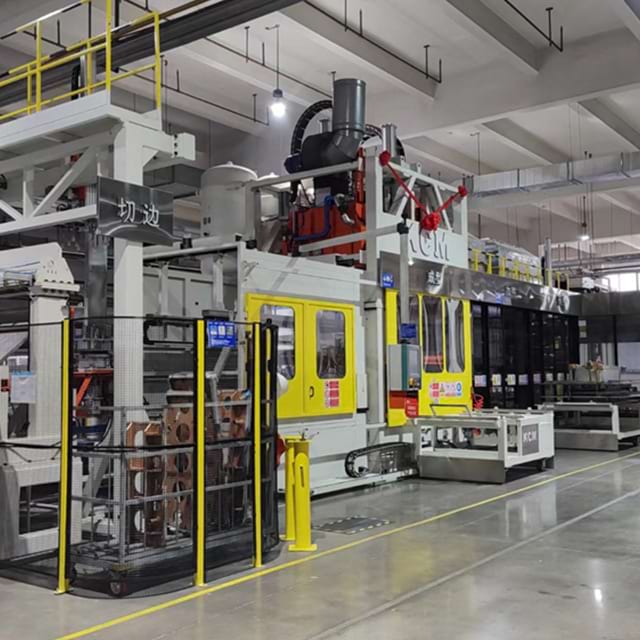
Modern production demands advanced heating matrices. Legacy ceramic systems are no longer sufficient. You need quartz or halogen heating elements for rapid, highly targeted zonal control. Zonal profiling allows you to apply different heat intensities across the sheet. This precision prevents the rapid center-sag inherent to HIPS. Simultaneously, it ensures the rigid edges of ABS reach optimal forming temperatures. A high-quality refrigerator liner thermoforming machine relies on these exact heating capabilities.
Hydraulic systems are obsolete for this level of material transition. You must upgrade to plug-assist servo motors. Servo-driven plug assists provide precise speed and depth control. ABS and HIPS have vastly different stretch ratios. You need programmable servos to manage these varying material behaviors. Precise plug control prevents bottoming out and eliminates corner webbing.
Cooling systems directly dictate your cycle times. HIPS retains less heat than ABS. It cools down and releases from the mold much faster. This characteristic can significantly shorten your overall cycle time. However, you only gain this speed if your machine features optimized cooling fans and water-chilled platens.
Table 1: Processing Comparison between ABS and HIPS
Parameter | ABS | HIPS |
|---|---|---|
Forming Temperature | 160°C – 190°C | 130°C – 170°C |
Melt Strength | High / Stiff | Low / Prone to sag |
Moisture Sensitivity | Hygroscopic (Needs drying) | Low (No pre-drying) |
Chemical Resistance | Excellent against blowing agents | Poor (Needs capping layer) |
Shrinkage rate discrepancies cause major headaches during material changes. Plastics shrink differently as they cool. ABS generally shrinks between 0.3% and 0.8%. HIPS has a lower shrinkage rate, typically between 0.2% and 0.6%. You cannot simply use an existing Vacuum Thermoforming Mold designed for ABS to run HIPS. Doing so results in loose tolerances. These dimensional errors lead to assembly failures during the foaming process.
Draft angles and ejection mechanisms require careful review. ABS is a stiffer material. It requires smoother mold finishes and slightly more generous draft angles. These angles prevent the plastic from scuffing or locking onto the tool during ejection. HIPS is more forgiving during ejection but still needs proper draft calculation.
Venting and surface finish optimization are critical for HIPS. HIPS forms under lower pressure than ABS. Therefore, it requires optimized vacuum hole placement. You must strategically place these holes in deep-draw corners. Crisper drawer recesses are prime examples. Proper venting prevents air entrapment and ensures sharp, accurate corner details.
Defect rates often spike when factories switch materials. You will likely encounter specific defects during changeovers. Webbing occurs when excess material folds over itself. Uneven wall thickness happens when plug speeds are mismatched. Chill marks appear if the tool is too cold during material contact. Identifying these common rejection causes is your first step toward process stability.
We strongly advocate for utilizing fractional factorial Design of Experiments (DOE) methodologies. Do this during your initial rollout phase. A fractional factorial DOE helps you isolate critical variables quickly. You can test heater temperature, plug speed, and vacuum delay simultaneously. This statistical approach saves weeks of trial and error on the factory floor.
Validating the switch requires strict metrics. Establish clear success criteria before approving a full production run on a new Vacuum Thermoforming Machine. Common success metrics include:
Maintaining a minimum corner thickness of strictly greater than 0.8mm.
Achieving a maximum acceptable cycle time that meets production quotas.
Passing environmental stress cracking resistance tests post-foaming.
Ensuring zero webbing in intricate crisper drawer geometries.
Procurement teams face tough decisions when buying new equipment. First, decide between inline and offline extrusion integration. An inline system is directly fed by a sheet co-extrusion line. This setup is generally better for HIPS. It leverages the residual heat from extrusion. Conversely, running from pre-cut sheet pallets is often safer for moisture-sensitive ABS. Pallets allow for controlled inline drying right before forming.
Next, evaluate whether to retrofit or replace. You need a framework for this decision. Upgrading an existing machine’s PLC and heating oven might seem cost-effective. However, older frames often cannot handle high-speed servo plug assists. If your rejection rates remain high after a PLC upgrade, you waste money. Investing in a new, dual-capable system often yields better long-term reliability.
Hold your vendors to strict requirements. List mandatory questions to ask OEMs during the bidding process. Focus on performance guarantees. Ask about recipe-storage capabilities in the HMI. A modern HMI should let operators switch from ABS to HIPS with one button press. Ensure the vendor offers robust remote diagnostic support. This remote access allows engineers to troubleshoot heating faults without traveling to your facility.
Key criteria when interviewing machinery vendors:
Do they provide binding performance guarantees for both ABS and HIPS?
Does the machine software support multi-recipe storage for quick changeovers?
Are top and bottom heating zones entirely independent?
Does the OEM offer 24/7 remote diagnostic support?
The true cost of switching between ABS and HIPS is measured in process control, not just resin per pound. You must look beyond the initial material invoice. Poorly managed changeovers destroy profit margins through high defect rates and assembly failures. Accurate thermal management and precise mold design are your best defenses against these losses.
Investing in high-precision, servo-driven thermoforming equipment is non-negotiable. Optimized tooling tailored to specific shrinkage rates is the only verifiable way to secure your margins. By applying rigorous DOE methodologies and demanding versatile machinery, you can confidently alternate between materials. Take control of your production variables today to ensure flawless appliance assembly tomorrow.
A: Yes, provided it has independent top/bottom zonal heating controls, recipe-saving capabilities in the PLC, and adjustable plug-assist profiles to handle differing melt strengths.
A: Often due to low environmental stress crack resistance (ESCR). HIPS is highly susceptible to chemical attack from certain polyurethane blowing agents unless specifically formulated or capped with a protective layer.
A: Usually, yes. The different thermal shrinkage rates mean a mold cut exactly for ABS will likely yield HIPS liners that are out of dimensional tolerance for final assembly.
A: Because ABS has higher inherent stiffness and impact resistance, manufacturers can sometimes down-gauge (use thinner sheets) compared to HIPS, which partially offsets the higher per-pound cost of ABS resin.


