
English 

+86-158-5501-9595
leizhang112@126.com
leizhang112@126.com
No. 8, Lanzhou Road, Su-Chu Modern Industrial Park, Chuzhou City, Anhui Province


Views: 134 Author: Site Editor Publish Time: 2026-09-04 Origin: Site


Investing in new production equipment carries massive stakes for your manufacturing floor. A high-CAPEX decision directly impacts unit costs immediately. It dictates daily cycle times and identifies production bottlenecks before they occur. Generic machine features often distract buyers from true production needs. A system excelling in high-mix prototyping will fail completely in continuous packaging operations. We frequently see manufacturers struggle when they misalign equipment architectures. Your daily throughput goals demand highly specific capabilities.
This guide provides a clear, vendor-agnostic framework. You will learn to evaluate technical specifications objectively. We explore crucial implementation constraints and facility readiness protocols. By the end, you will possess actionable evaluation metrics. You can confidently match machine capabilities to your exact production realities.
Align capacity with machine architecture: Choose between single-station, rotary, or inline machines based strictly on your target cycle times and volume requirements.
Scrutinize heating and vacuum limits: Component choices (e.g., quartz vs. halogen heaters, pump capacities) dictate material compatibility and forming precision.
Calculate True TCO: Base ROI calculations not just on the purchase price, but on energy consumption, tooling changeover times, and maintenance downtime.
Require rigorous FAT: Always mandate a Factory Acceptance Test using your specific molds and materials before finalizing procurement.
Before contacting vendors, you must define your production boundaries clearly. A Vacuum Thermoforming Machine performs optimally only when tailored to specific materials and dimensions. Standardizing your requirements upfront prevents costly misalignments later.
Map out the exact polymers you intend to process. Common industrial choices include ABS, PVC, PETG, and Polycarbonate. Each plastic behaves differently under intense heat. Thicker gauges require much higher heating densities. High-temperature materials demand robust heating elements. You must also ensure stronger vacuum draws for rigid polymers. Based on industry standards for polymer forming, varying melt indexes require highly specific control. PVC has a notably narrow processing window compared to ABS. Failing to match heater output to material thickness causes incomplete forming.
You need to define the maximum forming area precisely. Identify the deepest draw required for your largest parts. Buyers often make a critical mistake here. They plan to run the machine at its absolute maximum parameters continuously. Utilizing a machine at peak limits degrades part consistency over time. You should size the equipment so normal production runs at roughly 80 percent capacity. This buffer ensures uniform wall thickness. It also significantly reduces mechanical strain on the frame.
Your daily production mix dictates the ideal machine architecture. We categorize operations into two primary buckets.
High-Mix/Low-Volume: These facilities handle many different parts in smaller batches. You must prioritize rapid tool changeovers. Intuitive PLC controls become absolutely essential. Single-station setups usually fit this model best. Quick change capabilities prevent excessive machine downtime between jobs.
Low-Mix/High-Volume: These operations run the identical part for weeks. You need to focus heavily on automated material feeding. Multi-station rotary systems excel in this environment. Inline continuous web systems also minimize cycle times. Flexibility matters far less than raw speed and automation.
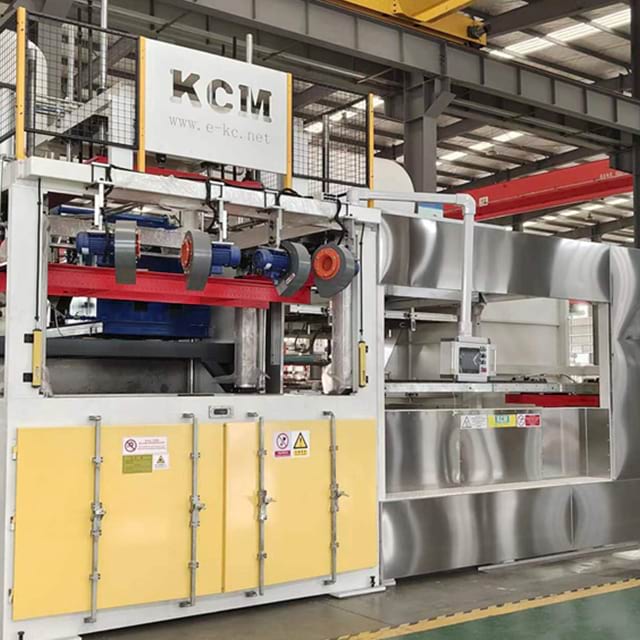
The market offers three primary machine architectures. Each serves a distinct production model. You must align your volume mix with the correct category. Selecting the proper Vacuum Thermoforming Machine depends entirely on balancing speed against flexibility.
Comparison of Core Machine Architectures
Machine Architecture | Ideal Application | Primary Advantage | Main Limitation |
|---|---|---|---|
Single-Station (Batch) | Prototyping, large custom panels | Low initial investment, small footprint | Slower cycle times, highly manual |
Rotary (Carousel) | Medium-to-high volume heavy-gauge | Overlapped heating and forming | Large footprint, complex maintenance |
Inline Continuous | High-speed thin-gauge packaging | Lowest cost-per-part at scale | Requires continuous roll-fed material |
Single-station setups perform all operations in one place. The material loads, heats, forms, and cools in a single static frame. This category remains best for prototyping. They handle low-volume runs perfectly. Manufacturers also use them for large structural components. Automotive dash panels and aerospace enclosures represent common examples.
These machines require a lower upfront capital expenditure. They occupy a significantly smaller facility footprint. However, they depend heavily on operator efficiency. Your cycle times will be slower. The operator must wait for each step to finish entirely before loading new material.
Rotary machines split the process into distinct zones. They usually feature separate loading, heating, and forming stations. They represent the absolute best choice for medium-to-high volume heavy-gauge forming. The carousel rotates material through each zone sequentially.
This architecture yields significantly faster cycle times. It overlaps the heating and forming processes efficiently. While one sheet forms, another heats simultaneously. The downside involves physical space. They require much more floor space. They also demand higher mechanical maintenance due to heavy rotating assemblies.
Inline systems process plastic directly from a continuous master roll. They move a continuous web of material through heating, forming, and trimming stages. This setup dominates thin-gauge, high-speed production. Clamshell packaging and food trays rely exclusively on this architecture.
Inline continuous systems offer the lowest cost-per-part at high scale. They achieve staggering production speeds. However, they demand a very high initial investment. They strictly rely on continuous roll-fed material. You cannot easily adapt them for thick-gauge structural sheets.
Do not purchase equipment based purely on marketing brochures. You must translate technical specifications into actual production yields. Component choices dictate your daily scrap rates.
Heating dictates the final quality of your formed part. You will typically choose between ceramic and quartz or halogen elements. Ceramic heaters offer incredible durability. They provide consistent heat over long lifespans. However, they suffer from slower response times. They take longer to heat up and cool down during shifts.
Quartz and halogen heaters provide a rapid response. They heat up almost instantly. More importantly, they offer highly zonal control. You can adjust temperatures across specific grid areas. Zonal control remains critical for complex parts. It prevents webbing on intricate molds. It also stops uneven thinning across deep draw sections.
Buyers often evaluate vacuum systems incorrectly. They look solely at pump horsepower. Do not evaluate pump horsepower alone. You must look at CFM (Cubic Feet per Minute). A common mistake involves sizing pumps based purely on static volume. You must account for dynamic flow requirements. High CFM ensures the system pulls air rapidly.
The presence of adequate surge tanks is equally important. Surge tanks store immense vacuum pressure. They release it instantly when the main valve opens. This instantaneous vacuum draw dictates detail capture. It ensures the plastic hugs the mold tightly before the sheet cools.
Cooling limits your maximum production speed. Production bottlenecks almost always occur in the cooling phase. You will choose between high-speed directional fans and water-chilled molds. Fans work well for simple, thin-gauge parts. Complex or thick-gauge parts require internal mold chilling. Under-sizing the cooling system artificially throttles the entire machine. Your heating and forming stations will sit idle. They must wait for the current part to cool sufficiently.
The machine's brain determines your daily operational efficiency. Evaluate the software interface carefully. It must allow easy recipe saving. Operators need to pull up previous settings instantly. Look for robust diagnostic capabilities. The HMI should pinpoint sensor failures immediately. Finally, check for ERP or MES integration. This ensures Industry 4.0 readiness. It allows you to track cycle times and downtime automatically.
Procuring equipment represents only half the battle. You must prepare your facility for implementation. Hidden operational hurdles can destroy expected profitability. Addressing these risks early ensures a smooth installation.
You must document the physical dimensions of the machine carefully. Include the required clearance around the perimeter for safe maintenance access. Check ceiling height clearances specifically for upper heater banks. Your facility must meet strict utility requirements.
Electrical Supply: Ensure adequate 3-phase power availability. Heating banks draw massive amperage during initial startup sequences.
Pneumatic Supply: Install dedicated, high-capacity compressed air lines. Air ejects parts and drives heavy pneumatic cylinders.
Cooling Water: Route chilled water lines properly if using water-cooled molds.
Evaluate how the machine handles mold mounting. Changeovers consume valuable production hours. Advanced systems feature pneumatic locking mechanisms. They eliminate manual bolting completely. Automated size adjustments move clamp frames via servomotors. These features save hundreds of hours annually. High-mix operations must mandate these rapid-changeover features to remain competitive.
Heating elements run continuously in many older machine setups. This draws substantial power daily. Request kilowatt-hour (kWh) consumption estimates from the vendor. Base these estimates on your specific cycle times. Do not rely on maximum rated power figures. Real-world consumption differs vastly from theoretical maximums. Efficient machines idle heaters during unexpected line delays.
Assess the learning curve for new operators. Complex equipment frustrates floor workers. Machines lacking intuitive recipe management increase scrap rates heavily. This typically happens during the first six months of rollout. Ensure the vendor provides comprehensive on-site training. The interface should speak the operator's language and minimize confusing sub-menus.
Selecting the right manufacturing partner mitigates long-term operational risks. You must enforce strict compliance and testing standards before signing any purchase orders.
Never compromise on operator safety. Verify all CE, UL, or OSHA-compliant guarding. The machine must feature easily accessible emergency stops. Light curtains should protect all pinch points. If an operator breaks the light beam, the machine must halt instantly. Request these safety certification documents upfront during the bidding phase.
Downtime destroys production schedules and client trust. You need guaranteed factory support. Ensure the vendor stocks critical wear parts domestically. These include heaters, vacuum seals, and pump vanes. If they ship parts from overseas, you risk week-long outages. Negotiate guaranteed lead times in your formal Service Level Agreement.
The FAT protects your investment completely. Demand a fully documented FAT at the vendor's facility. You must use your actual production material. Send them your most complex test mold. Never accept a machine based on dry-cycle times alone. A machine running without plastic proves nothing. It must form your parts to your quality standards before authorized shipment.
Summarizing the shortlisting logic requires operational discipline. Do not overbuy on raw capacity. Focus deeply on heating precision and control systems instead. Over-sizing a machine wastes capital and floor space. Under-sizing cooling or heating throttles your daily yield permanently. The right equipment bridges the gap between material constraints and long-term production stability. It integrates smoothly into your current facility footprint. We recommend documenting your exact part dimensions right now. Outline your cycle time goals and specific utility constraints clearly. Compile this data into a formal Request for Proposal (RFP). Send this detailed RFP to vendors to begin your evaluation process confidently.
A: The payback period generally ranges from 12 to 36 months. This timeline depends heavily on specific operational improvements. Scrap reduction plays a major role in faster returns. Modern machines also feature superior energy efficiency, lowering daily utility bills. Additionally, advanced automation offsets direct labor costs. Facilities running multi-shift operations usually see the fastest returns.
A: Retrofitting older equipment is sometimes viable. You can upgrade PLC systems and swap outdated heaters. However, fundamental structural issues remain. Older frames may lack the rigidity needed for modern speeds. Fundamental cooling bottlenecks are also difficult to engineer away. These inherent limitations often reduce the value of a retrofit compared to purchasing a modern system.
A: You should set realistic expectations for delivery. Lead times typically range from 12 to 24 weeks. This varies based on machine size and the level of required customization. Highly automated inline systems may require longer engineering phases. You must factor this timeline into your upcoming production planning and facility preparation schedules.
A: Plug assist is necessary for deep-draw parts. It physically pushes the heated plastic into the mold cavity before the vacuum activates. This ensures uniform wall thickness and prevents corners from tearing. You must specify plug assist before purchasing. It requires top-side pneumatic or servo integration that is difficult to add later.


